
A Brazilian heritage
The cashew tree, Anacardium occidentale, is associated with central and northeastern Brazil. Before European colonisation, Indigenous communities already used it and selected trees with desirable characteristics.
Source : University of Oxford · Anacardium occidentale ↗Expansion in the sixteenth century
Around the mid-sixteenth century, the Portuguese brought the cashew tree to India. Cultivation subsequently spread to Africa and Southeast Asia. The Portuguese name caju itself derives from the Tupi name acaju.
Source : University of Oxford · Anacardium occidentale ↗The apple and the nut: two different parts
The cashew apple is a fleshy part of the flower stalk. The kidney-shaped fruit at its end contains the seed sold as a cashew nut. The tree is now widely cultivated across tropical regions for this edible seed.
Source : Royal Botanic Gardens, Kew · Anacardium occidentale ↗Explore our selection
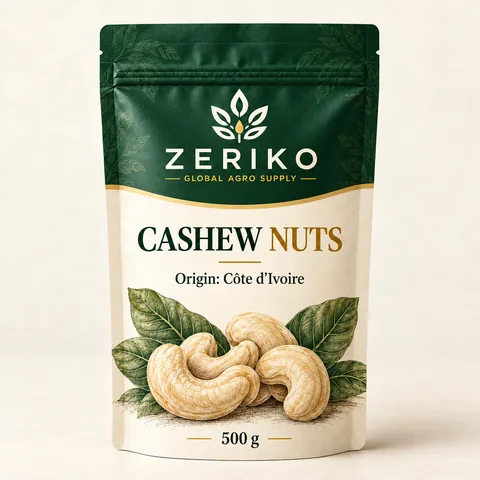
The ZERIKO cashew selection originates from Côte d’Ivoire, as specified by IMS CORP. Grades, preparation, specifications and packaging are detailed by quotation.
View products